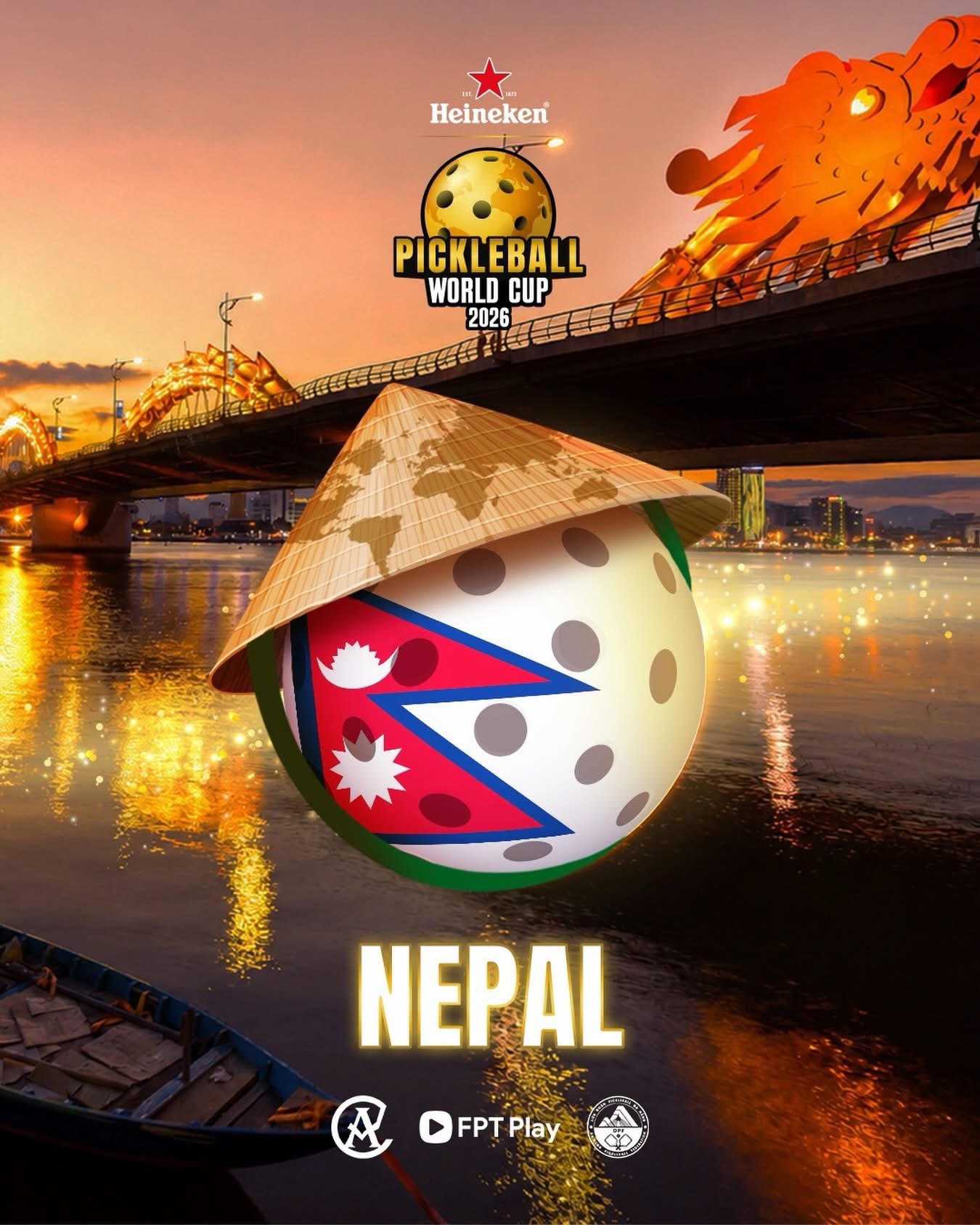
From Local Courts to the World Stage: Nepal’s Pickleball Journey Enters a New Era
Nepal’s rapidly growing pickleball movement reaches a historic milestone as the national team prepares to represent the country at the 2026 Pickleball World Cup in Da Nang, Vietnam
Pickleball, one of the world’s fastest-growing sports, is rapidly finding a strong and enthusiastic following in Nepal. What began as a relatively unfamiliar sport has evolved into a growing national movement, attracting players of different ages, developing competitive talent, encouraging youth participation, and creating new opportunities for Nepal to connect with the international pickleball community.
At the center of this development is the Pickleball Association Nepal (PAN), which has been working systematically to establish pickleball as an organized, competitive, inclusive and sustainable sport in the country. Through player development, coaching, tournaments, school programs, demonstrations, community activities and international participation, PAN is helping build the foundations of a sport with ambitions that extend from schools to the Olympic Games.
Nepal on the Global Pickleball Map
Nepal is preparing to participate in the 2026 Pickleball World Cup, scheduled to take place in Da Nang, Vietnam, from August 30 to September 6, 2026. The event will bring together national teams and the wider global pickleball community in what is expected to be one of the sport’s largest international gatherings.
The 2026 edition is particularly significant because it will be the first Pickleball World Cup hosted in Asia. Organizers and participating national federations expect thousands of athletes and participants from more than 80 countries and territories to converge on Da Nang.
For Nepal, participation in such an international event is far more than simply entering a tournament. It represents the country’s growing presence within the global pickleball ecosystem and provides Nepalese athletes with an opportunity to compete, learn and build relationships with players, coaches and sporting organizations from around the world.
The Nepalese delegation will carry not only the national flag, but also the aspirations of a growing pickleball community back home.
A Sport Growing Across Nepal
The rise of pickleball in Nepal reflects a broader change in the country’s sporting culture. The sport’s accessibility, relatively simple learning curve, social character and suitability for different age groups have helped it attract players from diverse backgrounds.
Pickleball can be enjoyed recreationally, but it also offers a clear pathway toward high-level competitive sport. That combination has helped the game gain momentum among young athletes, adults, senior players and people discovering organized sport for the first time.
Across Kathmandu and other parts of Nepal, pickleball courts and playing communities are increasingly becoming visible. More players are taking up regular training, while clubs, coaches and tournament organizers are contributing to a developing competitive environment.
PAN has also emphasized introducing pickleball to educational institutions, recognizing that schools can play a crucial role in developing the next generation of athletes. Its long-term vision of taking pickleball “From School to Olympic” reflects an ambition to build the sport from the grassroots upward rather than relying only on short-term tournament participation.
This approach is consistent with the broader global development philosophy of the Global Pickleball Federation, which emphasizes grassroots participation, recreational pickleball, competitive development, high-performance pathways and the sport’s potential contribution to healthy and active communities.
Building Players, Coaches and a Competitive Culture
The growth of any sport depends not only on the number of people playing it, but also on the quality of its development structure.
In Nepal, the focus is increasingly shifting from simply introducing pickleball to developing a proper sporting ecosystem—players, coaches, officials, tournaments, clubs, facilities and international exposure.
Regular training and competitive tournaments are helping Nepalese players understand the tactical, technical and physical demands of modern pickleball. At the same time, coaching and development initiatives are creating opportunities for players to progress from recreational participation toward serious competition.
PAN’s initiatives—including school-based programs, coach development, demonstrations, national competitions and international participation—are helping create a pathway through which a young player can discover pickleball, learn the fundamentals, enter competition and eventually aspire to represent Nepal internationally.
That pathway is essential if Nepal is to build sustainable success rather than relying on individual talent.
The World Cup: A Historic Opportunity for Nepal
The 2026 Pickleball World Cup provides an unprecedented platform for Nepalese players.
Taking place over eight days in Da Nang, the event will combine national-team competition with a major international pickleball festival. The competition will feature players and sporting communities from around the world, while Da Nang will serve as a meeting point for athletes, coaches, officials, fans and industry stakeholders.
For Nepalese athletes, competing against international opponents will provide invaluable experience. Every match will be an opportunity to understand different playing styles, improve tactical decision-making and gain confidence at the international level.
Equally important will be the experience outside the court.
International sporting events create opportunities for national federations to establish relationships, exchange knowledge, explore partnerships and learn from countries where pickleball has already developed sophisticated systems of coaching, competition and player development.
Nepal’s participation therefore has the potential to create benefits that extend well beyond the World Cup itself.
More Than a Tournament
For Pickleball Association Nepal, the World Cup represents an important milestone in a much larger national vision.
The objective is not simply to send players abroad. It is to bring international experience back to Nepal and use it to strengthen the sport domestically.
International exposure can help Nepalese players and coaches understand global standards. It can inspire young athletes to pursue the sport seriously. It can encourage sponsors and institutions to invest in pickleball. It can also demonstrate to policymakers and sporting authorities that pickleball has genuine potential as an organized competitive sport in Nepal.
The World Cup can therefore become a catalyst for the next phase of Nepalese pickleball.
A New Generation Is Emerging
Perhaps the most encouraging aspect of Nepal’s pickleball development is the growing interest among younger generations.
Schools provide an ideal environment for introducing children to the sport because pickleball can be adapted to different playing levels and age groups. With appropriate coaching and facilities, the sport can become an accessible pathway into competitive athletics.
The long-term goal is to develop players who can represent Nepal not only at regional competitions but also at major international events.
The journey from a school court to an international championship may take years, but every national-level player begins somewhere. Building that pathway today is an investment in Nepal’s sporting future.
Looking Beyond Da Nang
The 2026 World Cup should not be viewed as the destination of Nepal’s pickleball journey. It should be viewed as another important step.
Nepal has enormous potential to develop pickleball as a sport for all ages, a competitive discipline for elite athletes, a healthy recreational activity and a platform for international sporting engagement.
The country now needs continued investment in infrastructure, coaching, competitions, youth development, officiating, sports science and athlete support. Greater cooperation among government agencies, sports institutions, private-sector partners, schools, clubs and the pickleball community will be essential.
With a clear national development strategy, Nepal can move from participation to performance—and ultimately from emerging nation to competitive force in Asian and international pickleball.
Carrying Nepal’s Flag with Pride
As Nepal prepares to step onto the international stage in Da Nang, the significance of the moment goes beyond wins and losses. Every serve, rally and point will represent the determination of Nepalese athletes who have chosen to pursue a rapidly developing sport. Every appearance on the court will help introduce Nepal to the global pickleball community.
The 2026 Pickleball World Cup is therefore not simply another international tournament for Nepal. It is a statement. A statement that pickleball is growing in Nepal. A statement that Nepalese athletes are ready to compete internationally.
And a statement that the journey from school courts to the Olympic dream has begun. With growing participation at home, an increasingly structured development pathway and an enthusiastic national team preparing for the world stage, Nepalese pickleball stands at an exciting turning point.
From Kathmandu to Da Nang, from local courts to the world stage, Nepal is ready to make its mark in the global game of pickleball. The journey has begun. The future is bright. And Nepal is ready to play.